Tanzania
Serengeti
Unsplash / Unsplash
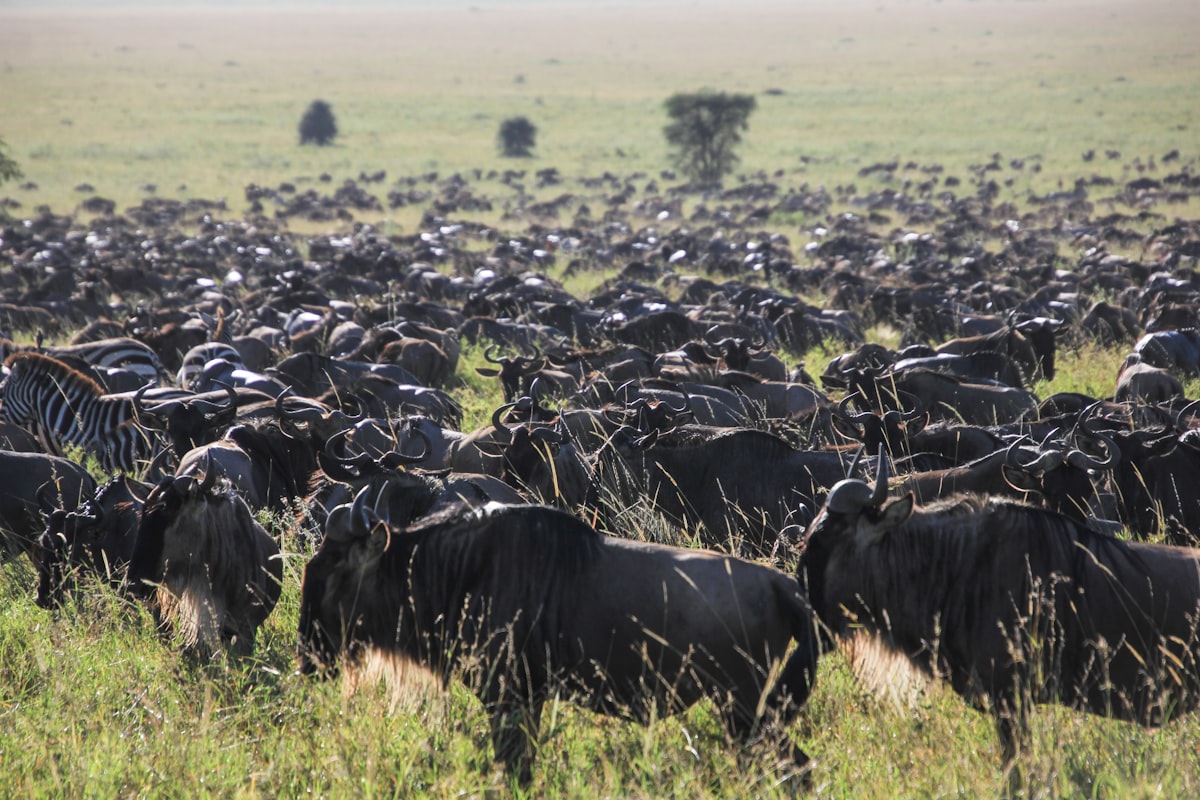
The world's most celebrated safari ecosystem — the Great Wildebeest Migration, the Big Five, and the open savannah that defined the idea of an African safari.
The Serengeti National Park covers 14,750 square kilometres of open savannah, acacia woodland, and granite kopjes, and contains the most famous wildlife event on Earth: the annual Great Wildebeest Migration of 1.5 million wildebeest and 200,000 zebra that moves in a clockwise circuit determined by rainfall and grass. The northern Serengeti (around Kogatende and the Mara River) is the location of the July–August river crossings — the most intensely dramatic wildlife moments the ecosystem produces. The southern Serengeti around Ndutu hosts the January–February calving season. The central Serengeti (Seronera) has the highest resident predator density year-round: the Seronera Valley lion prides, the leopards of the Seronera River, and the cheetah of the open plains are present every month. Safari camp quality ranges from mid-range permanent lodges to ultra-luxury private conservancy camps outside the park boundary.
Scores
Walkability
Transit
Price
Local feel
Nightlife
Family-friendly
Centrality
What you gain
- ↑The Great Wildebeest Migration is the singular reason to visit East Africa for many travellers — the Mara River crossings of July–August (1.5 million animals, 3-metre crocodiles, lions on both banks) and the February calving season (400,000 calves in 3 weeks, the highest predator concentration on Earth) are two distinct events that reward separate visits in different months
- ↑Resident Big Five year-round: the Serengeti is one of a handful of places on Earth where lion, leopard, elephant, buffalo, and black rhino can be observed in a single multi-day visit; the Seronera Valley cat population is the most accessible and reliably sighted of any African park
- ↑Balloon safari at dawn: a 90-minute hot air balloon flight over the Serengeti at sunrise (US$500–600 per person) followed by a bush champagne breakfast is one of the finest experiences available in East Africa — the combination of scale, silence, and wildlife visible from above creates a perspective that ground-level game drives cannot replicate
What you sacrifice
- ↓The Serengeti is expensive: mid-range permanent lodges start at US$500 per person per night all-inclusive, and the best mobile camps during migration season reach US$1,500–3,000 per person per night; Tanzania is not budget safari country, and cutting costs on accommodation significantly reduces the quality and location of the experience
- ↓Access from Arusha requires either a charter flight (45 minutes, US$300–500 each way) or a 6–7 hour drive on rough roads; the Serengeti is remote, and the distance from any urban service infrastructure is meaningful for medical emergencies
Best for
Avoid if
Other Tanzania neighbourhoods
The gateway city — a coastal East African metropolis, the Mafia Island marine park, and the ferry connections to Zanzibar and Pemba.
The world's largest intact volcanic caldera — a self-contained Eden with the highest wildlife density of any African park.
Africa's highest peak — a free-standing volcanic mountain walkable to 5,895m without technical climbing, through five distinct climate zones.
Know where to stay — now find when to go.
Best time to visit Tanzania →