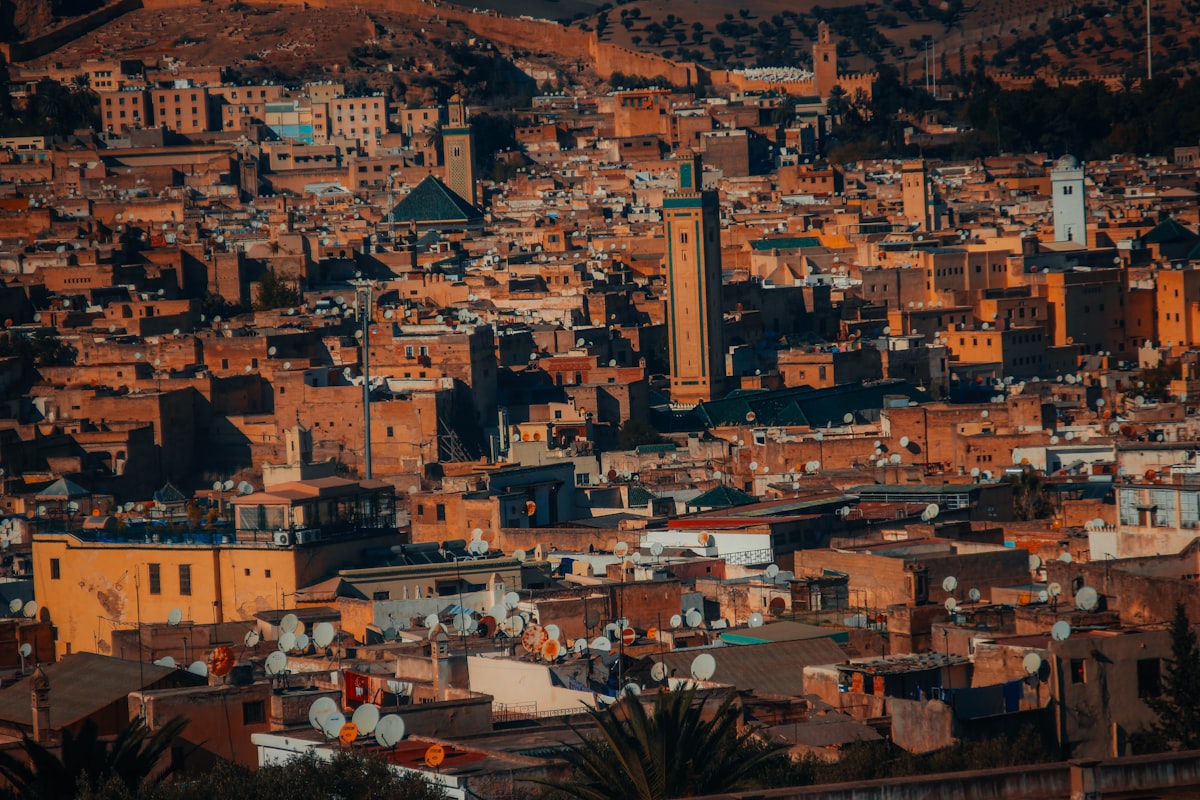
Fez
Fez el-Bali (Old Medina)
Unsplash / Unsplash
The world's largest living medieval city — 9,400 streets, 14th-century madrasas, and the Chouara tannery.
Fez el-Bali is the UNESCO-inscribed medina that defines Fez: a walled city of 156,000 people living in a street pattern established in the 9th century, where no cars have ever penetrated and donkeys remain the primary freight transport. The Al-Qarawiyyin mosque and university (founded 859 AD, the world's oldest continuously operating educational institution), the Madrasa Bou Inania (finest Marinid architecture in Morocco), the Chouara tannery (leather processing unchanged since the 11th century), and the Al-Attarine souk (perfume and spice market) are all within the medina walls. Staying inside Fez el-Bali — in a traditional riad — is the defining Fez experience.
Scores
Walkability
Transit
Price
Local feel
Nightlife
Family-friendly
Centrality
What you gain
- ↑The Madrasa Bou Inania (entry 70 MAD, approximately USD 7) is the finest example of Marinid architecture in existence: the interior courtyard with its carved cedar wood muqarnas, zellige tilework to 4m height, and marble water basin achieves a decorative complexity that Moroccan craftspeople have spent 50 years trying to replicate in new buildings. Built 1351–1357, it remains in use as a mosque and Quranic school.
- ↑The Chouara tannery — visible from the surrounding leather shop balconies on the Rue Chouara (entry free with mint sprig provided to offset the smell) — is the most authentic industrial process visible anywhere in the Islamic world: stone vats containing pigeon dung (for softening), quicklime (for hair removal), and natural dyes (saffron for yellow, indigo for blue, poppy for red) have been processing leather using the same methods since the 10th century. The workers stand knee-deep in the vats.
- ↑The riad accommodation experience in Fez el-Bali is the most intimate and architecturally extraordinary in Morocco: traditional courtyard houses with central fountains, orange trees, and hand-painted ceilings that open onto medieval alleyways. Riad Laaroussa, Dar Bensouda, and Riad Fes are the benchmarks — but smaller, cheaper riads throughout the medina offer similar architecture at fraction of the price.
What you sacrifice
- ↓Navigation in Fez el-Bali without a guide or excellent maps is genuinely difficult: the 9,400 streets include hundreds of dead-end derbs (private alleys), and the absence of landmarks visible from street level makes disorientation near-universal. Google Maps has improved dramatically but still has gaps in the most complex medina sections.
- ↓The medina experience is physically demanding: uneven surfaces, steep gradients, and the relentless sensory intensity of the souks, donkeys, and human traffic require more energy than visitors typically expect. July-August midday heat compounds this significantly.
Best for
Avoid if
Other Fez neighbourhoods
The French colonial grid — restaurants, patisseries, and the most liveable base outside the medina walls.
The Jewish quarter and Royal Palace gates — a second historic city within the city, almost unvisited.
The southern medina gateway — the Batha Museum palace and the most local section of Fez el-Bali.
Know where to stay — now find when to go.
Best time to visit Fez →