Jordan
Petra & the South
Unsplash / Unsplash
The rose-red city carved by the Nabataeans — the Siq, the Treasury, the Monastery, and one of the ancient world's most extraordinary urban achievements.
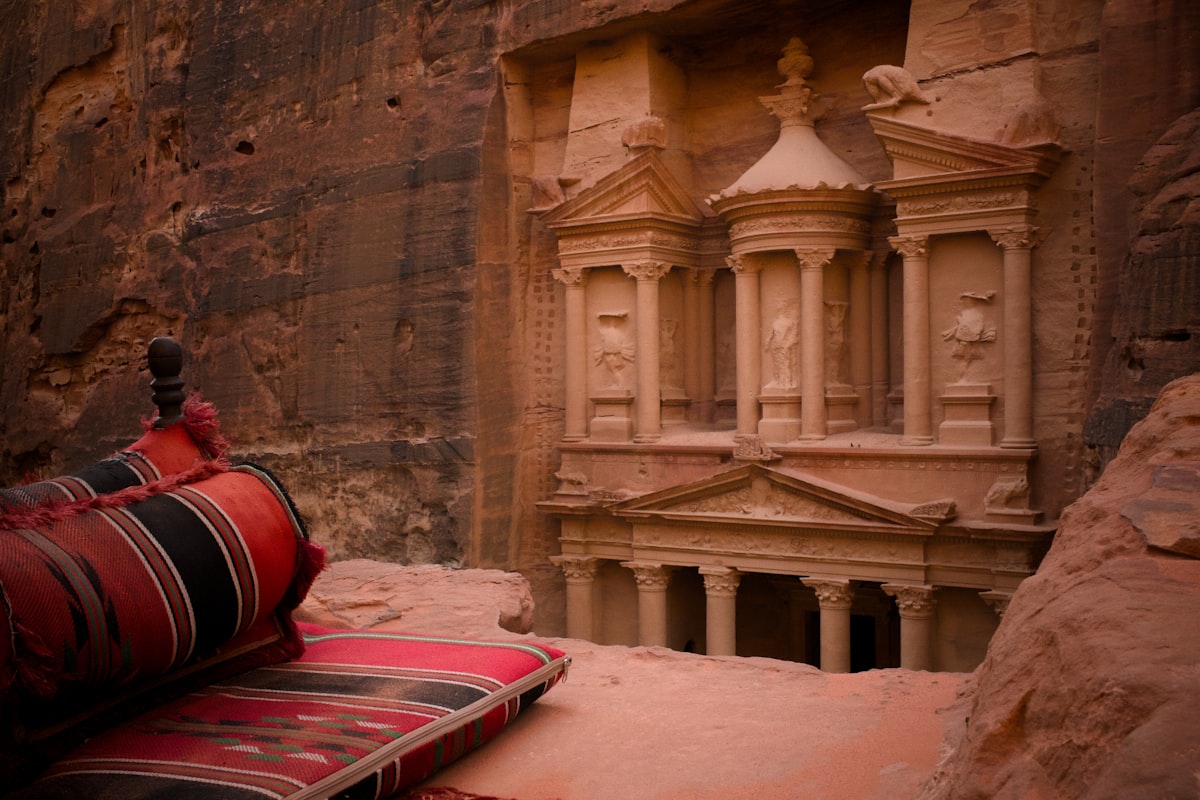
Petra is the capital of the ancient Nabataean kingdom and one of the world's great archaeological sites: a city of 30,000 people carved directly from rose-red sandstone cliffs in a hidden valley in southern Jordan between the 4th century BC and the 1st century AD. The site covers 264 square kilometres, with only 15% excavated. The primary access route is the Siq — a kilometre-long natural gorge barely 3 metres wide, its sandstone walls stained in swirling bands of crimson, ochre, and purple — which deposits visitors directly in front of the Treasury (Al-Khazneh), a 40-metre-tall carved façade that is the defining image of Jordan. Beyond the Treasury lies the main thoroughfare with the colonnaded street, royal tombs, the Great Temple, and the 800-step trail to the Monastery (Al-Deir), an even larger façade with a sun terrace and panoramic desert views. The gateway town of Wadi Musa has good hotels and restaurants. The nearby Siq al-Barid (Little Petra) is a miniature version of the same carved architecture entirely free to visit.
Scores
Walkability
Transit
Price
Local feel
Nightlife
Family-friendly
Centrality
What you gain
- ↑The Siq at first light: arriving at Petra's gate when it opens at 6am means walking the kilometre-long gorge in near-total solitude, with the morning sun just beginning to catch the upper sandstone walls; emerging from the Siq's final bend to see the Treasury façade fully lit and almost no other visitors is one of the most cinematic moments in world travel — an experience that disappears by 9am when tour coaches arrive
- ↑The Monastery (Al-Deir) trail: the 800 rock-cut steps above the main valley deliver travellers to a façade larger than the Treasury (50 metres wide, 45 metres tall), carved into a summit cliff with a terrace café and 360-degree desert views; this is Petra beyond the tour group circuit — the Monastery receives perhaps 15% of the visitor volume of the Treasury and rewards those who make the 45-minute climb
- ↑Petra By Night (Monday, Wednesday, Thursday evenings): the entire Siq is lined with 1,500 sand candles and the Treasury is softly illuminated; sitting cross-legged in the Treasury basin while a Bedouin musician plays rebab and the candles flicker against the rose-red rock is one of the most atmospheric heritage experiences in the Middle East; arrive before the 8:30pm start to get a front-row stone to sit on
What you sacrifice
- ↓Petra is physically demanding — the full day circuit from the Siq entrance to the Monastery and return is 12+ kilometres with 400m of elevation gain on uneven rock; in summer (June–August) this is genuinely dangerous in afternoon heat, and even in spring and autumn the 6am start rule applies to avoid the heat and crowds simultaneously
- ↓The site entry price is the highest single-day attraction cost in the Middle East: JOD 50 for a 1-day pass (approximately US$70), JOD 55 for 2 days, JOD 60 for 3 days; the Jordan Pass (JOD 70 for the 1-night itinerary, JOD 75 for 2+ nights) includes multiple visits and is essential for anyone spending more than a day
Best for
Avoid if
Other Jordan neighbourhoods
The Levantine capital — a city of seven hills, Ottoman souks, the Citadel above the Roman Theatre, and the finest food scene in the Arab world.
Float at the lowest point on Earth and dive the Red Sea coral gardens — Jordan's two sea experiences bookending the desert.
The Valley of the Moon — a UNESCO-protected desert of red sand, towering sandstone jebels, Bedouin camps, and the finest stargazing in the Middle East.
Know where to stay — now find when to go.
Best time to visit Jordan →