Nepal
Annapurna Region
Unsplash / Unsplash
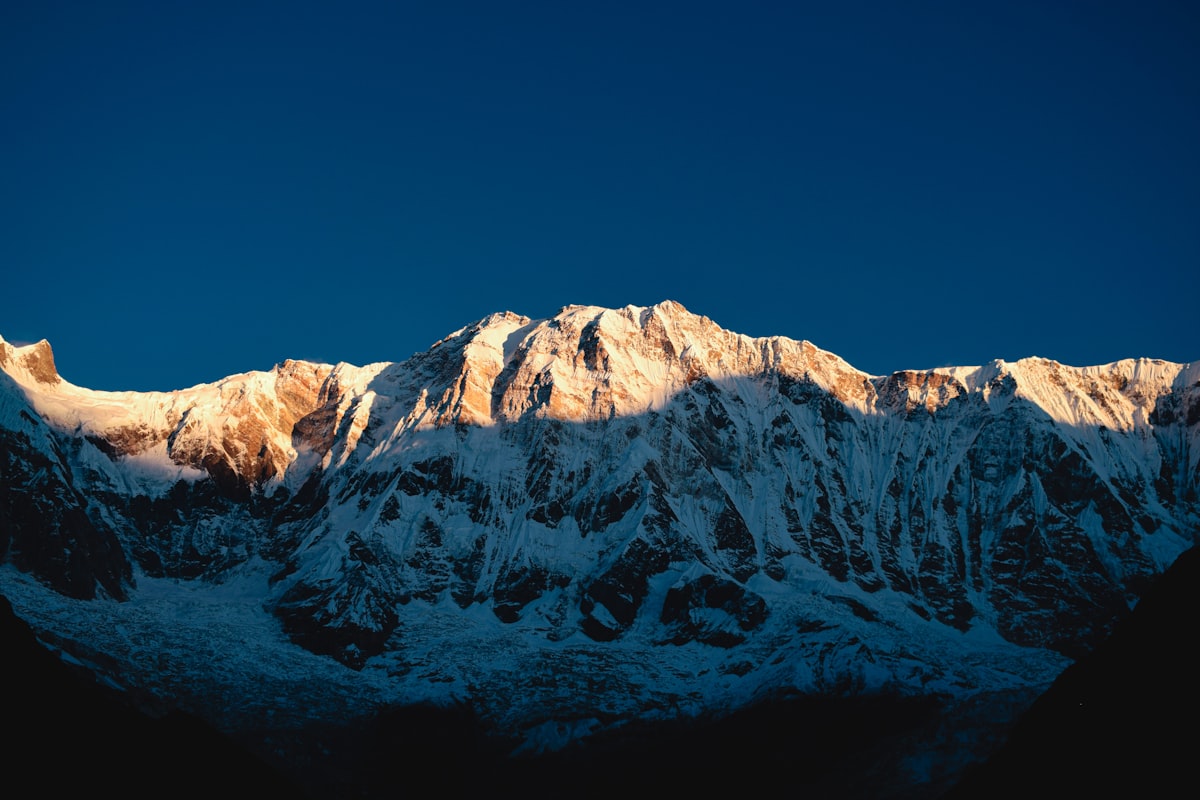
Nepal's most diverse trekking circuit — the Annapurna Circuit, Poon Hill sunrise, Annapurna Base Camp, and the transition from subtropical jungle to Tibetan plateau.
The Annapurna Conservation Area is Nepal's most visited trekking region and its most ecologically diverse: a single circuit crosses subtropical forest at 1,000m, terraced rice paddies, rhododendron forest bursting pink and red in spring, the high-altitude arid plateau of Mustang at 3,500m, and the 5,416m Thorong La pass — the highest point on any Nepal trekking circuit — all within a 2-week loop accessible from Pokhara. The classic Annapurna Circuit (14–21 days) is the world's most celebrated long-distance trek, but shorter options exist: the Poon Hill trek (4–5 days) from Ghorepani provides the most accessible panoramic Himalayan sunrise in Nepal (Dhaulagiri, Annapurna South, Machapuchare at dawn), and the Annapurna Base Camp trek (10–12 days) deposits trekkers inside a 360-degree amphitheatre of 7,000–8,000m peaks at 4,130m. The region contains a mosaic of Gurung, Magar, Thakali, and Tibetan-influenced cultures, and the teahouse system is the best-developed in Nepal.
Scores
Walkability
Transit
Price
Local feel
Nightlife
Family-friendly
Centrality
What you gain
- ↑Thorong La pass crossing (5,416m) on the Annapurna Circuit: the pre-dawn start from Yak Kharka, the 4–5 hour ascent through snow and wind to the pass, and the dramatic descent into the Mustang plateau on the far side — arriving at the monastery town of Muktinath — is a single-day experience that defines the Annapurna Circuit; the transition from lush Himalayan valley to dry Tibetan landscape happens in one day
- ↑Poon Hill at dawn: the most accessible world-class mountain panorama in Nepal — a 45-minute uphill walk from Ghorepani village (2,874m) reaches the Poon Hill viewpoint at 3,210m at sunrise, where Dhaulagiri (8,167m), Annapurna I (8,091m), Annapurna South, and Machapuchare (the sacred "fishtail" peak) are illuminated in sequence by the rising sun; achievable by fit walkers in 4 days from Pokhara
- ↑The cultural transition on the Annapurna Circuit — from Hindu villages in the lower Modi Khola valley through Gurung settlements with their Buddhist prayer wheels and mani walls, to the Tibetan-plateau culture of Manang and the Upper Mustang region with flat-roofed whitewashed houses and sky-blue chortens — is the richest cultural progression of any Nepal trek
What you sacrifice
- ↓Road construction has affected the character of parts of the Annapurna Circuit: a jeep road now runs through much of the eastern section (Besisahar to Chame and beyond), and many trekkers now start the walk later at Dharapani or Chame to skip the road sections; the original sense of a pure wilderness circuit has been partially compromised by vehicle access
- ↓The Thorong La crossing is weather-dependent: the pass can be temporarily closed by snow storms in November and is risky in winter (December–February); a failed crossing due to weather requires retracing several days of trail or waiting at high altitude, and the altitude exposure at the pass carries genuine altitude sickness risk
Best for
Avoid if
Other Nepal neighbourhoods
UNESCO World Heritage at every turn — Pashupatinath's cremations, Bouddhanath stupa, three Durbar Squares, and the chaotic spiritual energy of South Asia's most sacred city.
Nepal's second city — Phewa Lake, direct Annapurna views, world-class paragliding, and the most relaxed base for the Annapurna region.
The world's most iconic trek — Everest Base Camp, the Sherpa capital of Namche Bazaar, and the Himalayan giants above 8,000 metres.
Know where to stay — now find when to go.
Best time to visit Nepal →